
As RBI governor, Sanjay Malhotra will have to give the highest priority to the interest of the economy while deciding on the growth-inflation trade off at Mint Street.

It will be the second Budget of the Modi 3.0 government and eighth straight Budget for Nirmala Sitharaman, rare in Indian polity.

'Not paying workers enough will end up being self-destructive or harmful for the corporate sector itself.'

'If you are in a position to give employment to local people, you will find no terror attacks in your area.'

'We don't have to go abroad for anything.' 'Anyone who thinks we have a lot to learn from the US needs to have his head examined.' 'We are in a new era.'

India stares at the risk of an influx of Chinese products as US tariffs on a range of Chinese goods, including solar panels, electric vehicles, lithium-ion batteries, syringes, and steel, are set to take effect from September 27. With higher tariffs reducing China's access to the US market, there is concern that China may divert its exports to other markets, including India, which could lead to potential dumping of goods. This situation could challenge Indian industries, particularly in sectors where competition with Chinese products is already fierce.

Concerned over the fallout of the Red Sea crisis and severe shortage of containers against the backdrop of a steep decline in merchandise exports in August, the Union government is pulling out all the stops to find a solution. To begin with, the government has devised a strategy aimed at boosting container supply and supporting exporters.

The fund will promote domestic shipbuilding of all types and sizes to reduce India's dependence on foreign ships.

The implementation of this toll collection system, which will eventually eradicate toll booths, necessitates the fitting of an on-board unit (OBU) in every vehicle that can track a vehicle's location in real time.
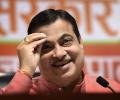
Days after saying that there is no need for subsidies to achieve greater penetration of electric vehicles (EVs), Union Minister of Road Transport and Highways Nitin Gadkari on Monday clarified that the view is his own, but any official call on EV subsidies is not one that he can take.

The central government's Great Nicobar development project, proposed around an unprecedented transhipment port, will be executed to keep environmental impact minimal, and is essential as it is of national importance, the government has said amid calls to abort the controversial project due to ecological concerns, the Centre said in an official statement.

'There will be 200 ITIs developed as hubs, while 800 will be developed as spoke, connected with five National Skill Training Institutes.'

'Given our turbulent neighbourhood, the prime minister is likely to emphasise on democratic dividend as the reason behind India's continuous prosperity.'

The steep cut in Customs duty on silver in the FY25 Budget to 6 per cent from 15 per cent may provide the government temporary relief by checking the spurt in silver imports from the United Arab Emirates (UAE) under the Comprehensive Economic Partnership Agreement (CEPA). In FY24, silver imports from the UAE jumped to $1.7 billion from only $11.18 million in FY23, according to commerce department data. In May, about 87 per cent of India's silver imports came from Dubai.

While Andhra Pradesh is expected to receive Rs 15,000 crore to Rs 20,000 crore, Bihar is likely to get Rs 5,000 crore to Rs 10,000 crore in FY25.

'The conspiracy is to end India's entrepreneurship culture even before it fully blooms.' 'Negativity is being spread in society towards all those who do business, and this hatred for business and wealth creators is spilling everywhere.'

'I found it unbelievable that L&T said 45,000 jobs were waiting to be filled because of unavailability of suitable skillsets.' 'So, when the Opposition sweepingly says there are no jobs, I'm sorry... I'm not saying it's raining jobs, but there are jobs. The (skill) gap has to be bridged.'

Government officials believe that central bridge projects perform better than state projects due to stricter checks and balances.

To boost domestic manufacturing under the Make in India initiative and reduce dependency on imports, the government is expected to announce in the Budget an increase in the minimum local content requirement for public procurement, with certain sectors being granted exceptions. Currently, firms producing goods, services, or works with at least 50 per cent local content are classified as Class-I local suppliers and are preferred the most in government procurement.

'There is no immediate threat to the government, and they would prefer the growth agenda.'
 © 2026 Rediff.com - Advertise with us - Disclaimer - Privacy Policy - Sitemap - Feedback - About us - Terms of use - Grievances